Learn Latest Dot Net & get placed as a Dot Net Full Stack Developer
CIIT's Dot Net Training is ideal for both freshers and working professionals interested in building a career as a Dot Net full stack developer.
Get Your Dream IT Job Just in 6 Months
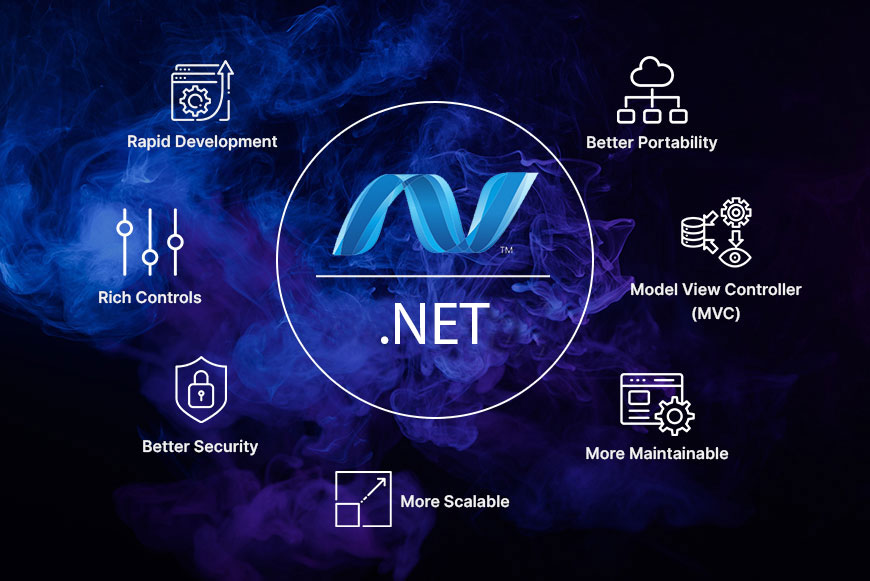
.NET Core is a free, open-source, and cross-platform software framework developed by Microsoft for building modern modern, high-performance applications. It represents a significant evolution of the earlier. NET Core, designed to be more lightweight, modular, and flexible. .NET is in demand due to its versatility, performance, and continued support from Microsoft. It is used across many industries, including finance, healthcare, and e-commerce, to build secure and scalable applications, with strong job growth in areas like cloud-based solutions (Azure) and cross-platform mobile development (.NET MAUI).
CIIT's .NET Full Stack Development course offers an ideal opportunity for individuals passionate about building projects from the ground up. CIIT serves as an excellent platform for those aspiring for boundless opportunities in the IT industry as a Dot Net Full Stack Developer.
Enquiry Now
Outcomes of the .NET Training
NET full-stack development training provides a comprehensive pathway to becoming a versatile software professional, equipping you with the skills to build, deploy, and manage entire web applications from scratch.
-
Modern Tech Stack Mastery:
Proficiency in C#, ASP.NET Core, Entity Framework Core, and SQL Server, combined with front-end frameworks like React, Angular, or Blazor.
-
End-to-End Development:
Master the full lifecycle of an application, from designing interactive UIs to implementing server logic and secure databases.
-
High Employability:
Most learners secure job-ready roles within 6–12 months of completion.
-
Diverse Job Roles:
Graduates qualify for positions such as Full Stack Developer, .NET Developer, Software Engineer, Cloud Developer, and Solution Architect.
-
Salary Growth:
In India, entry-level salaries typically range from ₹4.5 – ₹6.5 LPA, while mid-level professionals (3–5 years) can earn ₹10 – ₹15 LPA. Certified engineers often see a 20–40% hike in their current packages.
-
Problem-Solving & Soft Skills:
Enhanced ability to debug across layers, communicate technical trade-offs to stakeholders, and work effectively in Agile environments.
With flexible learning options—both online and offline—you will receive expert-led instruction, job assistance, and certification guidance to fast-track your career in dot net.
Weekdays (Mon-Fri) - 6 Months
Weekends (Sat & Sun) - 7 Months
Course Information
Batches Available: Weekdays/Weekends
Training Mode: Classroom & Online
Language: English, Hindi, Marathi

100% Money Back Guarantee
5-Day Money-Back Guarantee : Till date We have trained 10000+ candidates including under graduates,fresheres and working professionals with expert knowledge. All are satiesfied with our training quality. So we are giving guarantee to all those who want to join our institute that if you're disappointed for whatever reason, you'll get your 100% refund. We won't make you invoke any rules or conditions – if you're not satisfied within your first 5 days then we'll refund you without any excuse.
Our Alumini works at Top MNCs & Indian Companies. So Can You!
What are the Benefits of Full Stack .Net Developer?
A full stack .NET developer possesses knowledge of both user interface technologies (like HTML, CSS, JavaScript, Blazor) and server-side frameworks (such as ASP.NET Core, C#). This combination allows them to independently build and manage complete applications
High Employability and DemandOrganizations prefer professionals who can manage end-to-end software development. Full stack developers reduce the need for large teams by managing both front-end and back-end tasks, making them a top choice in hiring decisions.
Better CompensationBecause of their wide skill set, full stack .NET developers often earn higher salaries than developers who specialize in only one part of the tech stack. Their ability to handle diverse responsibilities adds to their overall market value.
Greater Project OwnershipThey are capable of understanding and managing every layer of a software project, from designing the user interface to integrating with databases and deploying to servers. This leads to better control and deeper involvement in projects.
Career Growth OpportunitiesHaving expertise across various technologies opens up several career paths, including roles like Software Architect, Tech Lead, or Solution Engineer. Over time, they can even move into leadership or consulting positions.
Improved Problem SolvingFull stack .NET developers can quickly identify and fix issues as they arise in both client and server components. This ability to see the bigger picture helps streamline development and reduce downtime.
Ideal for Freelance and StartupsSince full stack .NET developers can manage full project cycles alone, they’re well-suited for freelance work and early-stage startups where teams are small but projects are still demanding.
Faster Development CyclesWhen a single developer manages both the front-end and back-end, communication gaps are reduced, and development progresses faster. This agility is beneficial in environments that require rapid delivery.
Broad Technology ExposureWorking across the stack introduces developers to a wide range of tools and frameworks such as Visual Studio, Entity Framework, LINQ, Azure DevOps, SQL Server, and REST APIs—building a rich and varied skill set.
KEY Features that Makes Us Better and Best Campus For You
Expert Trainers
Training will be provided by Industry experts with extensive experience
State-of-the-Art Infrastructure
Modern facilities and tools for an engaging learning experience.
Comprehensive Curriculum
In-depth courses designed to meet current industry standards and trends.
Flexible Schedules
Options for weekday, weekend, and online batches to suit your convenience.
Personalized Attention
Small batch sizes for individualized mentoring and guidance.
100% Real time Project Training
Real-world actual industry projects and practical sessions to become experienced.
100% Placement Assistance
Dedicated support to help you secure your dream job.
Affordable Fees
Quality training at competitive prices with flexible payment options.
Lifetime Access to Learning Materials
Revisit course content anytime for continuous learning
Industry-Recognized Certifications
Globally accepted credentials to boost your career prospects.
Diverse Course Offerings
A wide range of programs in IT, business, design, and more.
Why Learn .NET in 2026?
-
Enterprise Dominance & Stability :
While startups often jump between trendy stacks, .NET remains the undisputed "gold standard" for banking, healthcare, and logistics. Companies in these sectors offer long-term job security and high-paying roles for those who master structured, strict coding environments.
-
Performance Leadership :
According to industry benchmarks, .NET (specifically ASP.NET Core) consistently out-performs other popular frameworks in tasks like JSON serialization and database access. In 2026, Native AOT (Ahead-of-Time) compilation has made .NET apps even faster and more memory-efficient, which is critical for cloud-native microservices.
-
The "AI-Augmented" Developer :
.NET has integrated deeply with AI. With C# 14 and built-in AI libraries (like Microsoft.Extensions.AI), developers can build LLM-powered applications and "agentic" tools more rapidly than in previous years.
-
True Versatility (One Language, Every Platform) : A single skill set in C# allows you to build:
Web: High-scale APIs and interactive UIs with Blazor.Cloud: Seamless integration with Microsoft Azure for serverless and containerized apps.Mobile/Desktop: Cross-platform apps using .NET MAUI.Games: Powering the majority of the world's mobile and indie games via Unity.
-
Better Career Entry for Juniors :
Unlike the "overcrowded" MERN stack market, .NET often has fewer applicants per role, making it easier for disciplined learners to stand out for junior positions.Projected 2026 Salary Packages (India)
- Fresher (0–1 yr): ₹3.5L – ₹6L
- Junior (1–3 yrs): ₹6L – ₹11L
- Mid-Level (4–7 yrs): ₹11L – ₹20L
- Senior / Architect: ₹22L – ₹45L+
Course Highlights
-
Front-End Development (Client-Side): This layer focuses on building the user interface and ensuring a responsive user experience.
Web Basics: HTML5 (Semantic tags, Forms, Media) and CSS3 (Flexbox, Grid, Animations).Responsive Frameworks: Bootstrap 5 or Tailwind CSS for mobile-first layouts.JavaScript & TypeScript: ES6+ syntax, DOM manipulation, and TypeScript for type-safe code.Modern Frameworks: Angular (Modules, Components, RxJS) or React (Hooks, State, Props) are the most common industry choices
-
Back-End Development (Server-Side): This is the core "engine" of the application, typically built using the Microsoft ecosystem.
C# Language Fundamentals: Variables, data types, control flow, and deep dive into Object-Oriented Programming (OOP) principles.ASP.NET Core: Building web applications using MVC (Model-View-Controller) architecture and Minimal APIs.Web API: Designing and securing RESTful services with JWT (JSON Web Tokens) and OAuth2.ORM (Entity Framework Core): Database-first and code-first approaches, migrations, and LINQ queries.
-
Database Management:
Developers must manage data persistence and retrieval efficiently.
Relational Databases: Microsoft SQL Server.SQL Mastery: DDL/DML commands, Joins, Stored Procedures, Triggers, and Indexes.NoSQL (Optional): Introduction to MongoDB for non-relational data needs.
-
Advanced Topics & Design Patterns:
Architecture: Clean Architecture, Repository Pattern, and Dependency Injection (DI)Security: Security
By the end of this Dot Net Full Stack Development Course, you’ll be well-prepared to take on roles such as Dot Net Developer,Dot Net Full Stack Developer,Junior .NET Developer,Mid-Level .NET Developer,Senior .NET Developer,Back-End .NET Developer,Front-End .NET Developer, and drive innovation and efficiency in any organization.
Who can do?
-
Freshers & Graduates:
Students or recent graduates from fields like BCA, BSc (CS/IT), BE/B.Tech (CS/IT), and MCA are the most common candidates.
-
Career Switchers:
Individuals from non-IT backgrounds (e.g., commerce, arts, or management) can successfully transition through structured bootcamps.
-
Existing Developers:
Backend or frontend developers looking to master the other half of the stack.
-
QA & Manual Testers:
Professionals aiming to move into development roles by learning full-cycle application building.
-
Entrepreneurs:
Startup founders wanting to understand the full technical lifecycle of their product.
Dot Net Career Path
-
Junior Developer (0–2 Years)
Focuses on C# 12+ fundamentals, ASP.NET Core, and basic SQL. Expected to assist in coding and debugging within Agile teams.
-
Software Engineer (2–5 Years)
Manages independent modules, integrates APIs, and begins specializing in paths like Blazor (frontend) or Microservices (backend).
-
Senior Developer (5–8 Years)
Acts as a technical owner. Beyond coding, they are expected to design scalable architectures, mentor teams, and debug complex production issues.
-
Technical/Solution Architect (8+ Years)
Strategic leadership roles focusing on enterprise-wide system design, cloud-native migration (Azure/AWS), and cross-platform strategies.
Our Success Lies In Our Learner's, Success Stories
Explore our student's experiences and discover how we've helped them achieve their goals through excellence and dedication.

Vaibhav Saykar
One off the best institutes then other training institutions and specially for those students who wants to start their career for IT. i hope everyone can join with us Ciit training institute, recently I have placed so special thanks to all CIIT TEAM always support, gaide and give 🙏 Read Complete Feedback
Saurabh Lonkar
Learning at CIIT has been a truly rewarding experience. Trainers are very good — knowledgeable, approachable, and always ready to help. Each topic is explained clearly, and special attention is given to doubt-solving, which really helps in building a strong foundation.
Read Complete Feedback
Ajay Wagh
I recently completed the .NET Full Stack Developer course at CIIT Training Institute, and it was an excellent experience! The course content was practical and well-organized, helping me build strong development skills and real-time project
Read Complete Feedback
Kalyani Dhavale
I’m truly grateful for your mentorship throughout my journey with Python Selenium automation. Your deep expertise, structured guidance, and hands-on approach made complex concepts easy to understand. You not only helped me strengthen my technical skills ...
Read Complete Feedback
Anil Kamble
I had enrolled in October 2024 .Net Full stack Web Development batch. It is really fantastic learning experience. Mocks interview, topic revison, conceptual and practical approach with one to one doubt solving of mentors are really admirable.
Read Complete Feedback
Sagar Vyavhare
I had an excellent experience at CIIT Training Institute. The .NET Full Stack Developer course with React was comprehensive and well-structured. Special thanks to Leena Ma'am and Yuvaraj Sir for their expert guidance and hands-on approach...
Read Complete Feedback
Lubna Patel
As a Full Stack Development student at CIIT Training Institute, I can confidently say they provide excellent training from basics to advanced levels. With hands-on projects and internship opportunities, it's a great place to start your career in top companies.
Read Complete Feedback
PRAJWAL DIVEKAR
CIIT Training Institute is a great place to learn and grow, especially for those who want to start from basic to advance . they focus on providing best quality knowledge on the courses you choose with hands-on on projects and internship opportunities that helps to build real-world skills
Read Complete Feedback
Shesh Kumar Dwivedi
CIIT Training Institute offers excellent training in .NET Full-Stack Development. The instructors are knowledgeable and have designed a curriculum that covers everything from the basics to advanced topics. The hands-on projects are great for building practical skills...
Read Complete Feedback